

East of England Needs 30,000 Workers: What It Means for Property Jobs
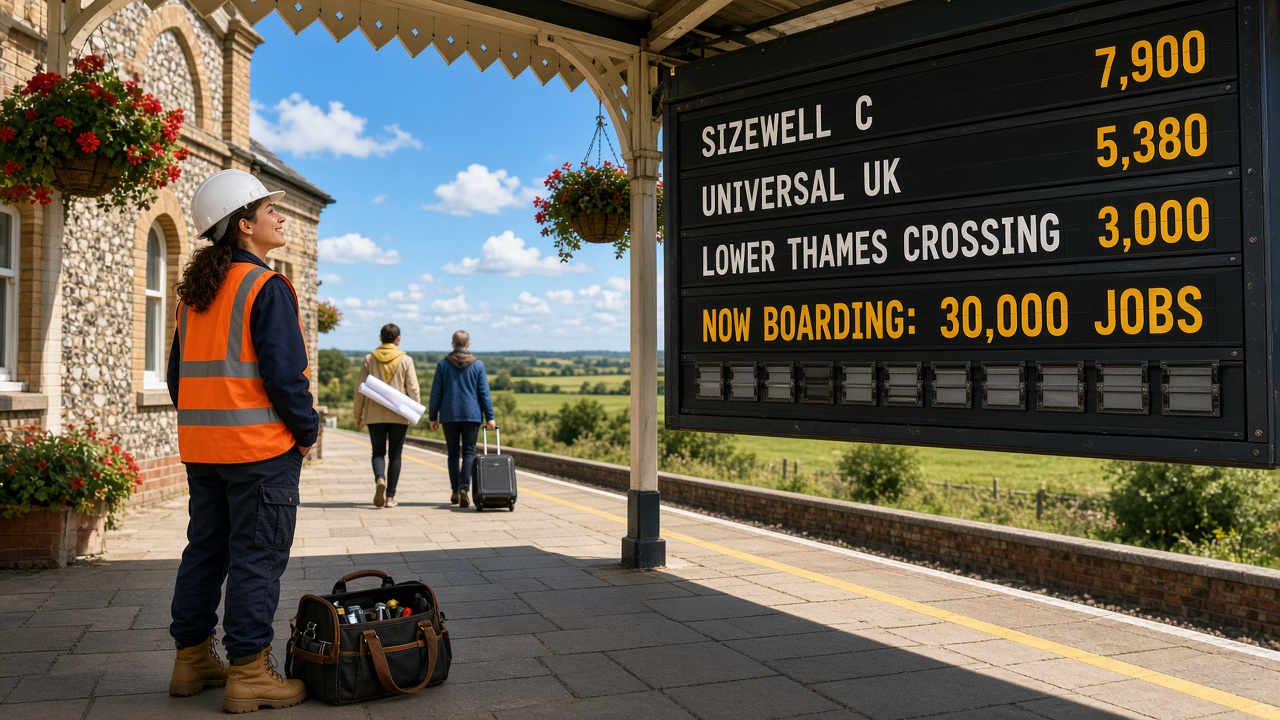
57 major projects in the East of England need up to 30,080 workers in five years. What it means for QS, site manager and construction careers and how to start.
By Brett Iredale
Most of the property news this month has been about what's slowing down. Housebuilders warning on profits, London schemes on pause, buyers waiting for rates to fall. So here's a story pointing the other way, and it's a big one.
The East of England needs up to 30,000 extra construction and infrastructure workers in the next five years, and right now it isn't training anywhere near enough of them. If you're starting out, switching careers or wondering where your next move should be, this is worth five minutes of your time.
What the report says
A new report, Opportunity East: Closing the Infrastructure Skills Gap, was launched at Westminster on 24 November by Local Government East and the East of England All-Party Parliamentary Group, and published on 25 November. The headline findings:
- The region has 57 Nationally Significant Infrastructure Projects planned, more than any other part of the UK.
- Together they could need up to 30,080 workers over the next five years.
- Many of them hit peak construction at the same time, between 2028 and 2030, so they'll be competing for the same people.
- Around 90,000 young people in the region aren't in education, employment or training.
The BBC's report on 25 November listed the biggest workforces needed:
| Project | Workers needed | Construction period |
|---|---|---|
| Sizewell C | 7,900 | Under way, to 2039 |
| Universal United Kingdom Resort | 5,380 | Now to 2031 |
| Lower Thames Crossing | 3,000 | Now to 2033 |
| Fenland reservoir | 2,000 | 2030 to 2036 |
| Norwich to Tilbury pylon scheme | 1,720 | 2027 to 2031 |
The BBC also notes East West Rail, the Luton and Stansted airport expansions, new power cables coming ashore in Suffolk and new towns at Tempsford and Gilston. The roles the report says these projects will fight over include civil engineers, project managers, electricians, steel fixers and quantity surveyors. Enterprise Essex adds plant operatives and construction managers to the list.
Local Government East chief executive Cairistine Foster-Cannan put it bluntly to the BBC: "We just haven't got the skilled workforce." The Minister for Growth, Dan Tomlinson, called the report "timely" and promised his civil servants would follow up.
Why this is a property careers story, not just an engineering one
It's easy to read "nuclear power station" and "pylons" and think this has nothing to do with property. I think that's wrong, for three reasons.
1. The core skills are property skills. Quantity surveyors, project managers, site managers and construction managers are exactly the people who build homes, offices and warehouses. A quantity surveyor who can control costs on a housing scheme can do it on a reservoir. A site manager who can run a 200-home estate can run a section of a rail project.
2. New towns are pure property. Tempsford and Gilston mean thousands of new homes, plus the planners, land buyers, development managers, new homes sales teams and, eventually, property managers that come with them.
3. When big projects hoover up talent, everyone else pays more. Our story earlier this week showed the East of England already tops the regional pay table for self-employed construction workers, at £1,185 a week in October according to Hudson Contract. Add 30,000 more jobs competing for the same people and that pressure only goes one way.
The other side of the coin: jobseekers are aiming too low
Here's the part that frustrates me. The day after the report, recruitment tech firm Tribepad published research, reported by Construction UK Magazine on 26 November, showing that among rejected jobseekers in construction and property:
- 32% have since applied for jobs below their skill level
- 23% have stopped going for more senior roles
- 20% have cut the pay they'll accept
- 50% say they've lost motivation
That's understandable. UK vacancies have fallen to 691,000, the lowest outside the pandemic since 2014, according to the ONS figures cited in the same piece. A few knock-backs and it's natural to start lowering your sights.
But look at the two stories side by side. On one hand, people with real skills are talking themselves down. On the other, a single region is warning it can't find 30,000 workers. My advice: don't trade down. Trade across to where the demand is.
What I'd do if I wanted in
- Look east. Live roles are already appearing. On Indeed this month, Barratt Redrow advertised an assistant site manager role in Littleport, Cambridgeshire and a trainee assistant site manager role in Thurston, Suffolk, while Sphere Solutions listed a site manager role in Poringland, just outside Norwich, at £300 to £340 a day (all still open when we checked on 27 November).
- Start in a trade or a site role. Assistant site manager, site engineer and trainee QS roles are the classic way in, and plenty of directors started on the tools. Our guide to breaking into property with zero experience covers the first steps.
- Get your tickets sorted early. A CSCS card, then SSSTS or SMSTS as you step up, makes you instantly more employable on large sites.
- Think about apprenticeships. The report calls for more youth hiring on major projects, and the Growth Minister says Cambridgeshire and Peterborough will run their own local apprenticeship services from next year.
- Already experienced? Know your worth. If you're a QS, project manager or site manager, 2028 to 2030 is going to be a seller's market in the East. Don't knock thousands off your asking salary because of one bad interview.
Where AI fits
Big infrastructure runs on paperwork: method statements, progress reports, cost reports, inductions. AI assistants like Grok Bot, Claude or ChatGPT can help you draft and summarise that faster, and they're a useful study partner for CSCS tests or a QS course. They won't pour concrete or manage a gang of steel fixers, so the human skills are what will still be in short supply.
Find your next role
The East of England is about to become one of the busiest places in the country to build a career in construction and property. Browse construction, site management and quantity surveying jobs on PropertyRoles.uk and set up an alert for the East, so you hear about the next big hiring push first.